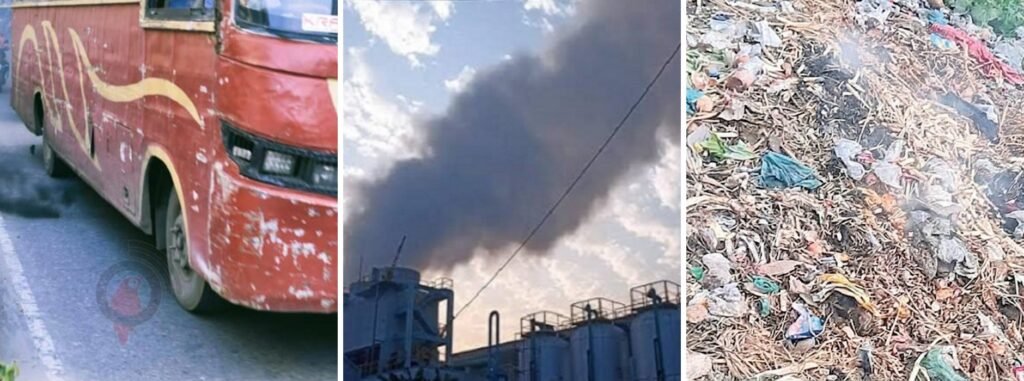
From diesel exhaust to burning garbage dumps, black smoke pours into Dhaka’s sky from a dozen directions every day. The sources are many — but so, thankfully, are the solutions.
By Dr. Md. Golam Faruque,
Md. Rakibul Hasan
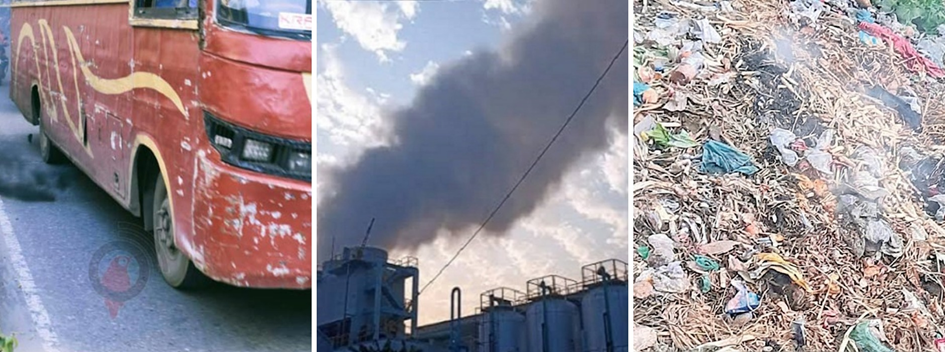
Stand at any major crossing in Dhaka during rush hour, and you will see it before you smell it: a thick, dark curtain unrolling from the tailpipe of an overloaded bus, swallowing the rickshaw puller pedalling beside it, the schoolchildren crossing the road, the vegetable seller squatting at the corner. Nobody chose to breathe that. But in Dhaka, nobody really has a choice.
Black smoke has become so common in this city that we have almost stopped noticing it — which is precisely the problem. Unlike pollutants that drift by unseen, black smoke announces itself. It is thick, dark, and undeniable. And yet, because it pours in from so many directions at once, it is easy to treat as a fact of city life rather than a crisis with a name.
It isn’t just the buses. On the outskirts of the city — in Narayanganj, Savar, and Gazipur — coal- and oil-fired factory boilers send black plumes into the wind, which the city then inhales. Along canal banks and roadside dumps, mountains of uncollected waste are routinely set alight, releasing smoke laced with dioxins and heavy metals. Construction sites add their own share of dust and diesel fumes. Four very different sources, one shared sky, and one city breathing all of it in.
This is not a small aesthetic nuisance. The soot in that smoke — black carbon, fine particulate matter, sulphur dioxide — settles into lungs and bloodstreams long before it settles anywhere else. Dhaka’s air regularly carries far more of it than international health guidelines consider safe, and the people most exposed are rarely the ones with any say in fixing it: traffic police standing at junctions for eight-hour shifts, rickshaw pullers, hawkers, and pedestrians who have no windows to roll up. The smoke does not stop at the lungs, either. It falls back to earth as acid rain, souring the water in the Buriganga and Turag, and settles as heavy-metal dust on roadside soil that later ends up in someone’s vegetable patch. Even Dhaka’s stubborn heat owes something to it: black carbon absorbs sunlight and turns the whole city into a slow-cooking pan.
“Every bus retired, every stack fitted with a filter, every dump replaced by a collection route is a small, achievable act of repair.”
It would be easy to end the story here, on a note of helplessness. But that would misrepresent the situation — and Bangladesh does not lack for tools, only for consistent will to use them. The Environment Conservation Rules already set clear limits on emissions and effluents. The Department of Environment already has the legal authority to inspect, fine, and shut down non-compliant industries, and BRTA already runs vehicle fitness tests. What’s missing is not a rulebook — it’s follow-through.
That follow-through can start in three concrete places. On the road, fitness testing needs to mean something: pre-2000 diesel buses and worn two-stroke engines that fail emission checks should actually be retired, not waved through at the depot gate. In industry, electrostatic precipitators and bag filters — proven, affordable technology — should be a condition of doing business, not a suggestion, with minimum stack heights enforced so smoke doesn’t settle directly over residential neighbourhoods. And for open burning, the answer isn’t prohibition alone; it’s giving the city somewhere else to put its waste, through organised collection routes, composting, and pilot waste-to-energy plants that turn a hazard into a resource.
None of this works, though, without visibility. Dhaka’s residents have no easy way of knowing, on any given day, how bad the air actually is — and regulators often learn about violations only after the damage is already public. A city-wide network of real-time air quality monitors, with readings published as openly as the weather forecast, would change that. So would treating industry not only as a target of enforcement but as a partner: the same kind of early, documented consultation that lets project managers seek the Department of Environment’s opinion before problems escalate could be extended more widely, turning compliance into an ongoing conversation instead of a once-a-year audit. Green buffer belts of trees along the worst-affected roads and industrial corridors offer a simpler intervention still — one that cities from Beijing to Bogotá have leaned on with real results.
None of these ideas are radical, and that is exactly the point. Dhaka does not need to invent its way out of the black smoke crisis. It needs to enforce, monitor, and invest — deliberately, and starting now. The sky over this city does not have to stay the colour of exhaust. Every bus retired, every stack fitted with a filter, every dump replaced by a collection route is a small, achievable act of repair. Multiplied across a city of more than twenty million people, those small acts are how Dhaka finally clears its air — and lets the next generation grow up breathing something better than smoke.